


Seeing What Others Don’t: The Remarkable Ways We Gain Insights by Gary Klein
In this fascinating exploration of human cognition, renowned psychologist Gary Klein moves beyond the typical focus on avoiding errors to answer a more positive question: How do we gain new understanding? Through a collection of real-world case studies—ranging from the discovery of DNA to smokejumpers escaping wildfires—Klein deconstructs the anatomy of the “aha!” moment and explains why our obsession with perfection often kills creativity.
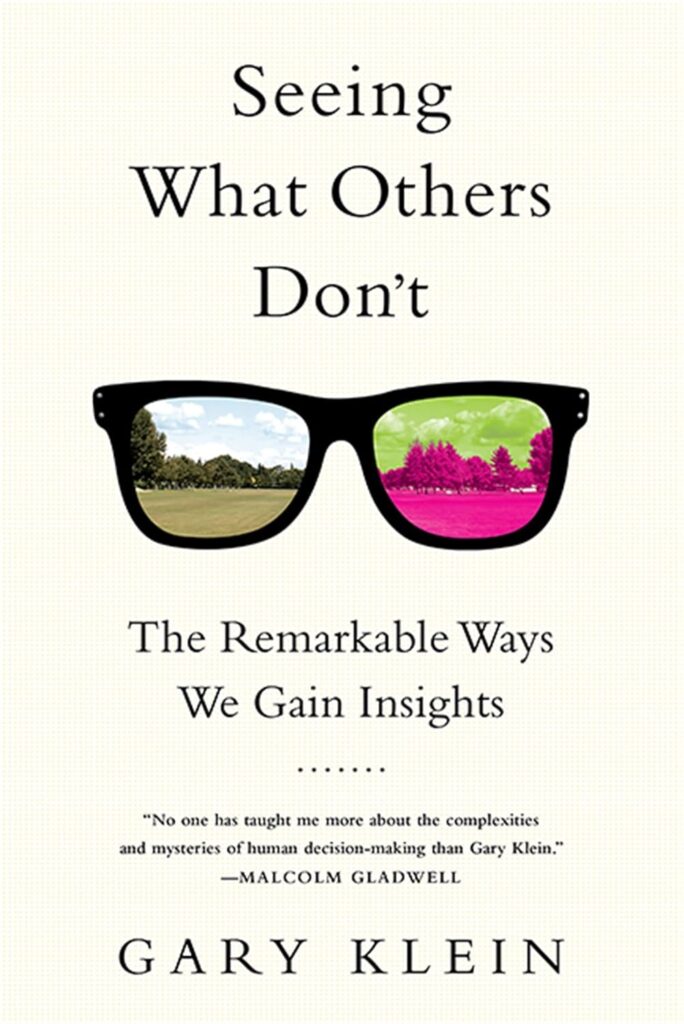
Seeing What Others Don’t: The Remarkable Ways We Gain Insights
Who Is This Book For?
- Business Leaders & Managers: particularly those trying to foster a culture of innovation within rigid corporate structures.
- Data Analysts & Researchers: who need to understand the human element behind connecting dots that algorithms might miss.
- Psychology Enthusiasts: specifically those interested in “Naturalistic Decision Making” and how experts think under pressure.
- Problem Solvers: anyone who feels stuck in their thinking and wants to understand the mechanics of breaking through a mental block.
Seeing What Others Don’t Key Takeaways or Themes:
- The Three Paths to Insight: Klein argues that insights generally arrive via three distinct avenues: connections (spotting a link), coincidences (noticing a pattern), or contradictions (spotting an anomaly that doesn’t fit).
- Performance = Insights – Errors: Most organizations focus entirely on the “Errors” part of the equation (reducing mistakes). Klein argues that by eliminating variance to stop errors, companies inadvertently eliminate the variance required for “Insights,” leading to stagnation.
- The “Dumb by Design” Problem: Information technology systems are often designed to filter out ambiguity. However, ambiguity is frequently where insight lives. By smoothing out data, we often blind ourselves to potential discoveries.
- Creative Desperation: Sometimes, insight is forced upon us. Klein uses the famous example of the Mann Gulch fire, where a smokejumper survived by lighting an escape fire—a counter-intuitive move born out of immediate, life-or-death necessity.
What Makes It Stand Out:
What separates Seeing What Others Don’t from other pop-psychology books is Klein’s methodology. He doesn’t rely on artificial lab experiments with college students. Instead, he analyzes 120 real-life cases of discovery.
Furthermore, this book acts as a fantastic counterweight to the popular “cognitive bias” literature (like Daniel Kahneman’s Thinking, Fast and Slow). While Kahneman focuses on how our intuition fails us, Klein focuses on how our intuition saves us and leads to brilliance.
Seeing What Others Don’t: Pros & Cons
Pros:
- Compelling Storytelling: The case studies—including how Harry Markopolos spotted Bernie Madoff’s Ponzi scheme when the SEC failed to—are gripping and illustrate the concepts perfectly.
- Actionable Frameworks: The “Up Arrow” (increasing insight) vs. “Down Arrow” (decreasing error) model is a powerful tool for diagnosing organizational health.
- Vindication for Intuition: It validates the experience of experts who “just know” something is wrong, explaining the cognitive processes behind that gut feeling.
Cons:
- Descriptive, Not Prescriptive: Readers looking for a simple “5-step checklist to become a genius” may be disappointed. The book explains how insight happens, but doesn’t necessarily promise you can trigger it on demand.
- Academic Pacing: While accessible, some middle sections regarding the classification of insights can feel slightly repetitive or dry to the casual reader.
Reader Reviews Snapshot:
Looking at reader feedback across major platforms, a pattern emerges:
- Common Praise: Readers frequently mention that the book changed how they view “best practices” and corporate procedures. The stories about the firefighters and military strategy are often cited as highlights.
- Common Critique: Some readers felt the distinction between the different “paths” to insight was a bit academic and that the book could have been condensed. A few mentioned they wanted more concrete exercises.
Final Thoughts:
Seeing What Others Don’t: The Remarkable Ways We Gain Insights
Seeing What Others Don’t is a vital read for anyone who feels that the modern obsession with data and error-prevention is missing something. Gary Klein provides the missing piece: the human capacity to spot what isn’t there. It is a thoughtful, well-researched defense of human expertise in an age of automation. If you enjoyed Malcolm Gladwell’s Blink but wanted more scientific substance, this is the book for you.
Conntact us: We would love to hear from you! Here’s how you can reach us:
Feel free to reach out with any questions, concerns.

